
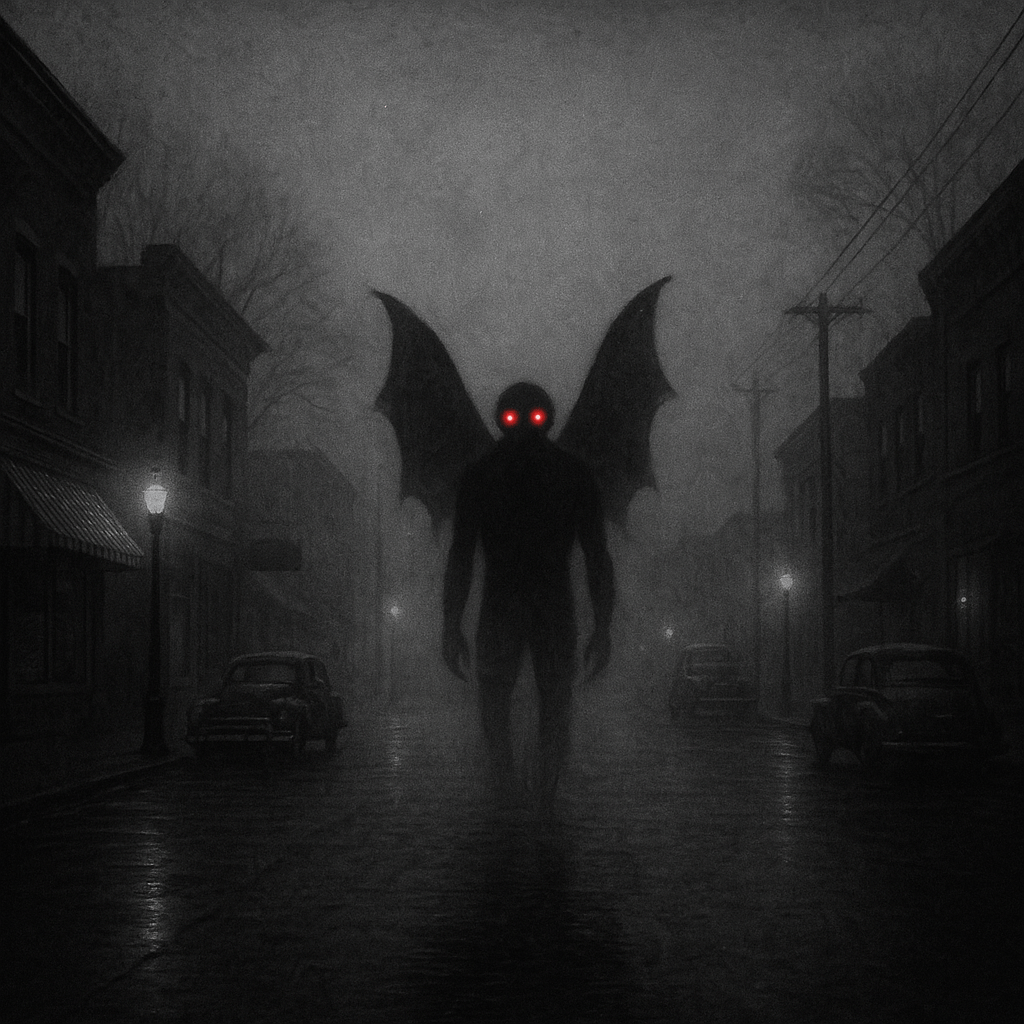
In the quiet riverside town of Point Pleasant, West Virginia, a legend took flight—literally. Along the shadowed banks of the Ohio River, stories have echoed for decades about a creature with glowing red eyes and enormous wings, known only as the Mothman. It’s a tale that began in the 1960s and has never fully landed, continuing to haunt the imaginations of skeptics and believers alike.
The earliest documented sighting occurred near Clendenin in November of 1966. A group of gravediggers preparing a burial reportedly looked up to see a figure emerging from the trees—man-shaped, but with wings, gliding overhead without a sound. Days later, just over 80 miles away, two young couples in Point Pleasant encountered what they believed to be the same entity. They described a towering figure, at least seven feet tall, with wings that spanned nearly ten feet. But it was the eyes—brilliant and red, almost burning—that lodged the experience deep in their memories. The creature didn’t just appear—it pursued, reportedly following their car at speeds exceeding 100 miles per hour, not flying like a bird, but gliding with unnatural ease through the air.
These sightings weren’t isolated. Over the next year, dozens of residents claimed to witness the creature in and around Point Pleasant. Some saw it soaring over the old TNT area—a sprawling site of abandoned World War II munitions bunkers, overgrown with weeds and soaked in eerie silence. Others claimed it landed near their homes or watched from wooded hillsides. Reports varied in detail but were consistent in tone: whatever it was, it felt wrong—unnatural, out of place.
Then, on December 15, 1967, tragedy struck. The Silver Bridge, which connected Point Pleasant to Gallipolis, Ohio, collapsed during rush hour, sending 46 people to their deaths in the icy river below. The disaster was blamed on a single faulty eyebar in the bridge’s suspension chain. But for many locals, it was more than a mechanical failure—it was a culmination. Sightings of the Mothman abruptly stopped after that day. To some, it seemed the creature had arrived as a warning, a dark herald of the catastrophe to come.
John Keel, a journalist and paranormal investigator, cemented this idea in his book The Mothman Prophecies, suggesting that the entity may be connected to other phenomena: strange lights in the sky, men in black suits, and psychological disturbances in those who saw it. Keel didn’t claim to fully understand what Mothman was—but he was convinced that something extraordinary had occurred in Point Pleasant.
Skeptics offer their own theories. Some believe the sightings were simply misidentifications of large birds—particularly the sandhill crane, which can stand nearly four feet tall and has a wingspan over six feet. With reddish patches around its eyes and a haunting call, it’s not an impossible candidate. Others suggest the entire wave of sightings was born from hysteria, fueled by newspaper headlines and a community ripe for supernatural storytelling.
Still, the Mothman legend refuses to fade. In fact, it has expanded. Reports of similar winged beings have surfaced around the world—before the 1986 Chernobyl disaster, in the days leading up to the Fukushima nuclear accident, and even in parts of Chicago. These alleged sightings suggest that Mothman is not tied to Point Pleasant alone but may be part of a global pattern—an omen, a psychic echo, or an interdimensional observer that appears when catastrophe is near.
Today, the town of Point Pleasant embraces its most famous resident. The Mothman Museum draws curious visitors from all over the world, and the annual Mothman Festival turns the streets into a celebration of mystery, folklore, and what-ifs. Statues and murals commemorate the creature, blending wonder with a wink of local pride. For many residents, the story has shifted from fear to folklore—a way to connect with the past and keep the town’s identity alive.
Yet, even amid celebration, a shadow lingers. What if it wasn’t just a story? What if something did break through that year in 1966—something watching, warning, or simply wandering through a crack in the known world?
The Mothman endures not just because it’s strange, but because it fits something deep within us: the sense that not everything has been explained. That sometimes, reality tilts just enough for something impossible to fly through. Whether as a creature, a sign, or a shared psychological event, the Mothman is part of a larger mystery—one that hovers at the edges of belief.
And in Point Pleasant, that shadow still passes through the trees. Not often, and not loudly—but just enough to keep the legend alive.
 Unknown Unseen