
Half a century ago, something strange stirred in a quiet home in Culver City. And what followed would haunt not just the house—but the very halls of UCLA. In the 1970s, universities across America flirted with fringe science. But at UCLA, one lab went further than most. Tucked away on the fifth floor of the Neuropsychiatric Institute was a modest parapsychology unit, led by Thelma Moss—a psychologist, former actress, and early advocate for psychedelic research. Between 1966 and 1978, this shadowy lab became a hub for those brave enough to study the unexplained. Moss attracted not only students but Hollywood stars and even covert visitors from the intelligence community. There were whispers of experiments designed to weaponize the mind, of consciousness projected across distances, and of the dead speaking through static and film grain. Among Moss’s closest collaborators were Barry Taff and Kerry Gaynor—two researchers whose lives would be forever altered by what came next.
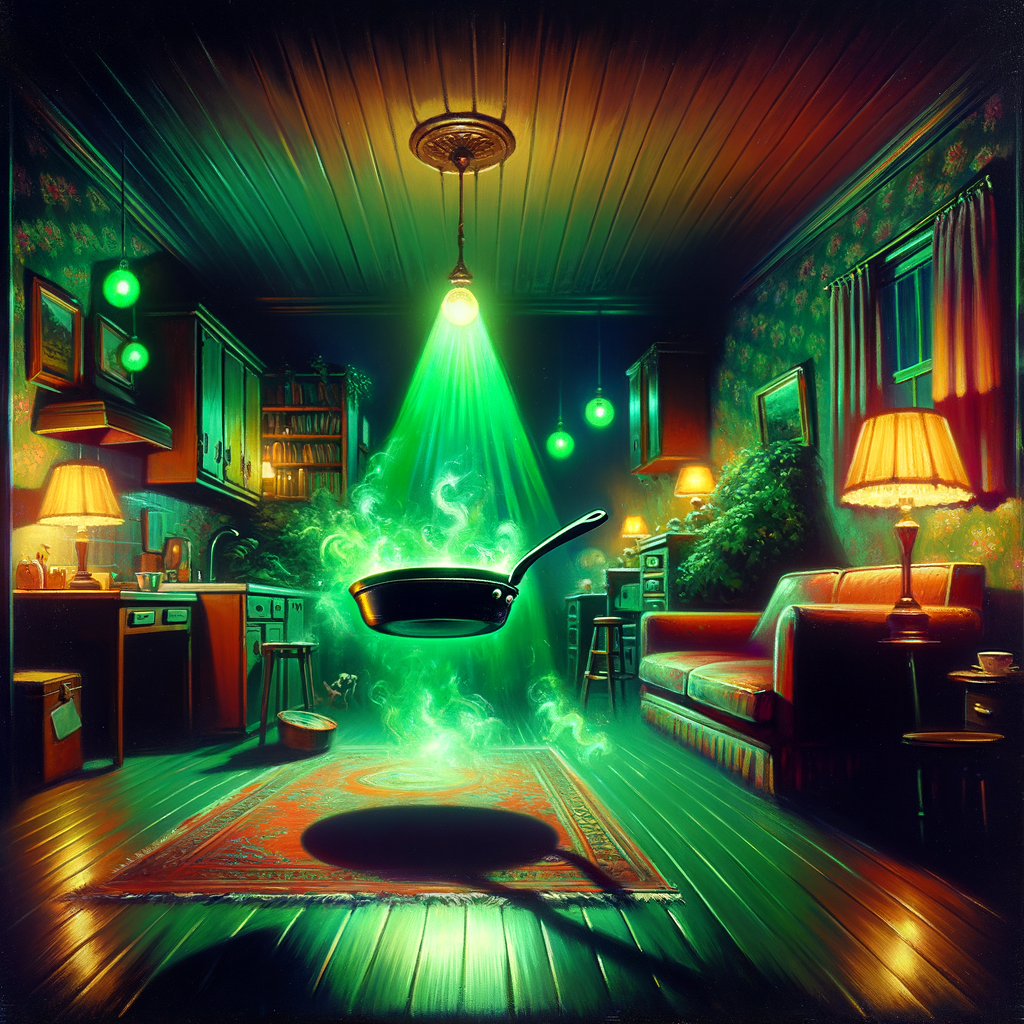
The story begins with a chance encounter. In the summer of 1974, Taff and Gaynor met a woman named Doris Bither at a bookstore in Los Angeles. She was anxious, guarded, and claimed to be under attack—by forces she couldn’t name. Her Culver City home, she said, was alive with hostile, invisible entities. Skeptical but intrigued, the two investigators agreed to visit. What they encountered was more than just creaky floorboards or a distressed homeowner. Doris’s house felt wrong. A tension hung in the air. And when a frying pan launched itself across the kitchen unprovoked, they knew they had stepped into something much bigger than a simple haunting.
For ten weeks, the house became a focal point of intensive observation. Taff and Gaynor documented cold spots, luminous orbs, disembodied voices, and, most famously, an eerie green mist that seemed to float through the air. Attempts to photograph or record the events often failed. Batteries drained. Equipment malfunctioned. And always—just before the activity peaked. The phenomenon seemed to center not on the house, but on Doris herself. When her teenage son played music, the activity intensified. Objects flew. Lights flickered. Shadows danced across the ceiling. The researchers noted that the house didn’t seem haunted—Doris did. Some began to wonder if she was a psychic catalyst, generating these events unknowingly. Others speculated about darker possibilities: trauma, poltergeist manifestations born from stress, or even interdimensional disturbances drawn to human energy.
Despite their efforts, Taff and Gaynor were unable to collect hard evidence. Photographs came out blurred or empty. Instruments captured anomalies, but never consistently. Skeptics dismissed the case as hysteria or confirmation bias. Still, those who were there speak of the events with a haunted certainty. Was Doris a victim of a classic poltergeist case—where unconscious psychic energy manifests physical disturbances? Or was something more ancient and malevolent at play? Some have compared the case to historical “entity attacks” described in folklore, where a person becomes a lightning rod for dark spirits. The truth remains frustratingly out of reach.
Doris herself remained a cipher. She resisted deep questioning, offered little about her past, and was rarely seen outside the investigations. What little is known paints a picture of a woman battling invisible enemies—both in the walls of her home and, perhaps, within herself. She died in 1999, never fully understood. Some believe she suffered from undiagnosed mental illness. Others argue she was highly sensitive—psychically open to realms most of us will never perceive. The case inspired the 1982 film The Entity, though the real story remains far stranger than fiction.
By 1978, the parapsychology lab at UCLA was shuttered. Officially, it was due to funding issues and a shifting academic climate. Unofficially, some believe the university grew uncomfortable with what the lab was discovering—or failing to explain. Taff and Gaynor continued their work independently, but nothing they encountered again ever matched the volatility of the Doris Bither case. Even today, Taff insists that what he witnessed in Culver City defies rational explanation.
Why did the phenomena intensify around Doris? Was she truly the source—or just a conduit? Could intense emotional trauma manifest as physical events? And why did so many of the recordings and photographs fail—almost as if whatever was there didn’t want to be seen? Fifty years later, no one has solid answers. Just fragments. Just shadows. But sometimes, that’s all a mystery needs to survive.
Have you ever felt watched in an empty room? Heard a sound you couldn’t explain? Perhaps the walls remember more than we do.
 Unknown Unseen