
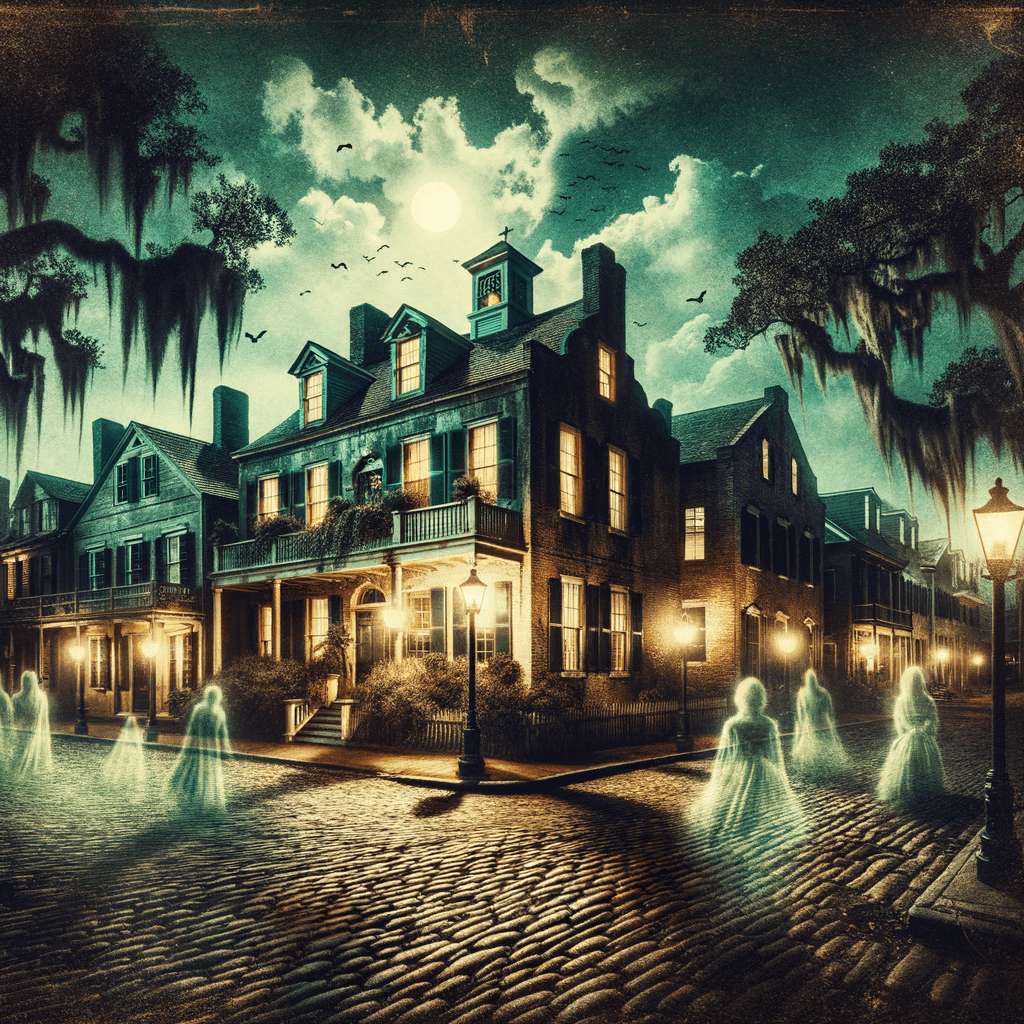
In the shadowy depths of Savannah, Georgia, lies Calhoun Square—a place where time folds in on itself and history lingers not just in the stories passed down, but in the air itself. Among the city’s 22 iconic public squares, Calhoun bears the weight of a particularly troubled past. Unlike the manicured charm and polished façades of its sister squares, Calhoun is steeped in silence, its beauty masking a deeper unrest. Here, the past isn’t past. It walks with you.
Flanking the square are two homes steeped in supernatural lore: the Espy House and the infamous 432 Abercorn Street. Each has its own tale, chilling in its own right, yet both seem bound to the same uneasy current that runs beneath the square’s ancient cobblestones.
By day, Calhoun Square is an image of Southern grace. Spanish moss drapes from aged oaks. Tourists drift by, snapping photos of the Wesley Monumental United Methodist Church that looms with Victorian elegance over the square. But as dusk deepens into night, the square shifts. Locals report a sudden drop in temperature. Lamps flicker. Whispers curl through the trees. It is then that Calhoun Square begins to speak.
What lies beneath the surface, quite literally, is the source of much speculation. In the early 2000s, a discovery was made that would cast a new light on Calhoun’s quiet corners. During utility work, unmarked graves were uncovered beneath the square’s soil. These were the final resting places of enslaved African people, interred without ceremony or record. It is believed that many of these graves date back to the 19th century, though their exact number remains unknown.
This discovery collided with another grim detail: the building that once stood adjacent to the square was Savannah’s first public school for white children, which was later repurposed as a makeshift hospital during the Civil War. Imagine the layers of suffering: enslaved individuals buried in silence, wounded soldiers gasping their final breaths, and children taught atop the dead. The square is more than haunted; it is saturated with unresolved grief.
These stories are not just historical footnotes—they seem to manifest. Witnesses recount shadowy figures drifting across the square at night. Some report hearing cries in a language they cannot identify. Others describe a sensation of being watched, even when the square appears empty. Paranormal investigators have registered anomalous EMF readings, inexplicable cold spots, and disembodied voices caught on recorders.
And then, there are the houses.
The Espy House, a dignified antebellum structure on the edge of the square, is home to a tale of forbidden love and brutal retribution. The legend centers around a young man named Wesley, said to be the son of the home’s original owner. Wesley fell in love with someone deemed inappropriate by his father—a servant or possibly someone of mixed race, depending on the retelling. When the relationship was discovered, the father is said to have reacted with violent fury. Wesley was either killed or driven to suicide, and his spirit never left. Visitors to the Espy House report strange thumps, flickering lights, and the occasional apparition of a young man staring forlornly from an upper window.
A few blocks away sits one of Savannah’s most infamous addresses: 432 Abercorn Street. This home has been the subject of ghost tours, documentaries, and endless online speculation. The most persistent legend involves a young girl who lived there in the 19th century. After disobeying her strict father’s orders, she was allegedly confined to a sunless room as punishment. The story goes that she died there, malnourished and alone. To this day, some claim her face can be seen peering from the window. Others report lights turning on and off in an empty house, voices murmuring from behind locked doors, and the chilling sensation of a child’s presence brushing past in the dark.
Skeptics dismiss these tales as urban legend, but the persistence of the accounts is hard to ignore. More intriguingly, some theorists suggest that the two houses—Espy and Abercorn—may be linked not just by location but by the spectral residue of trauma. Could these hauntings be expressions of the same deep wound? Could Wesley and the girl be bound not just by their tragic ends, but by the very earth that holds the forgotten dead?
Calhoun Square, with its unmarked graves and eerie echoes, might well be the heart of that wound. It is a place that forces us to confront uncomfortable truths. The ghosts here are more than echoes; they are reminders. Of injustice. Of sorrow. Of the people history tried to forget.
Today, visitors stroll through Calhoun Square, unaware of the layered tragedies beneath their feet. Children laugh near benches built over burial grounds. Brides pose for wedding photos in front of the Wesley church. But those who know, those who have heard the whispers or felt the cold brush of something unseen, walk with caution.
For in Savannah, the veil between the past and present is always thin. And in Calhoun Square, it may be nearly gone.
 Unknown Unseen