
Category: Cryptids

  • The Mothman Mystery: West Virginia’s Winged Enigma

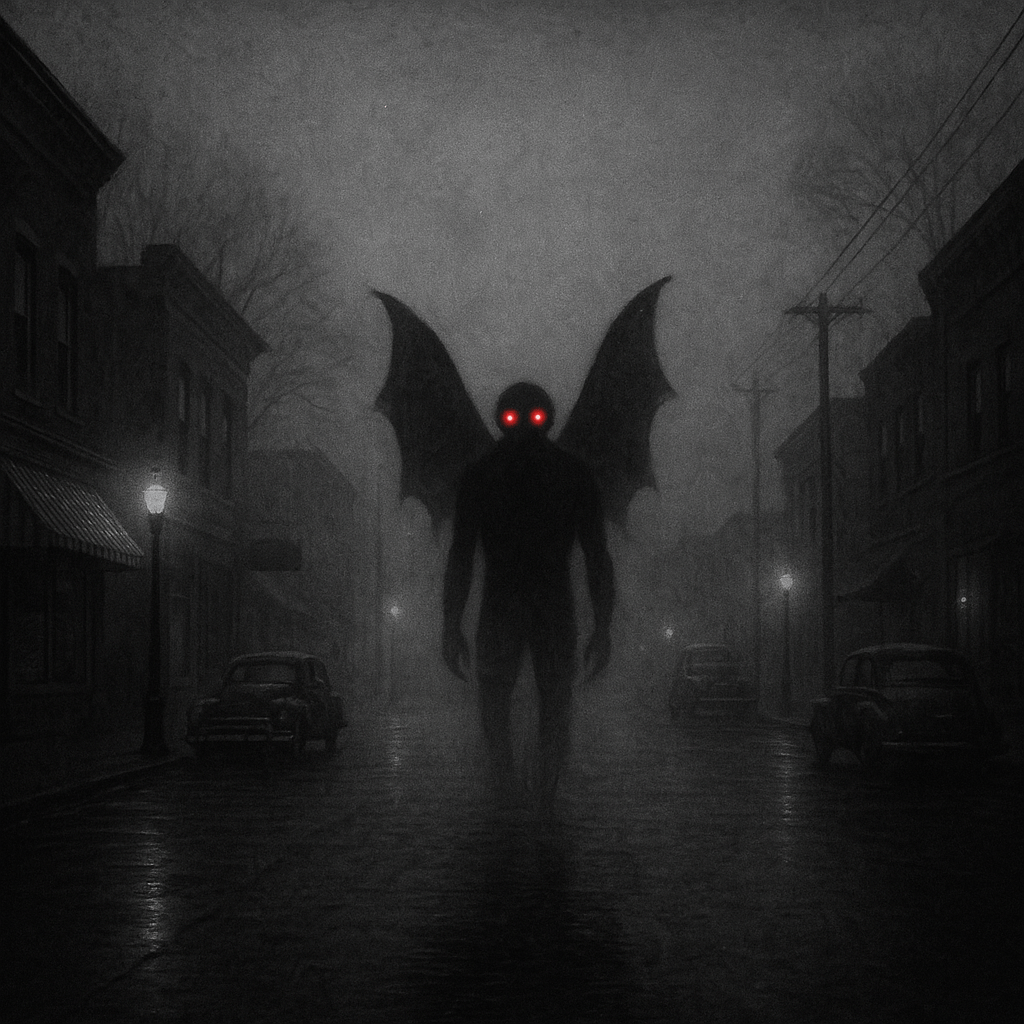
    In the quiet riverside town of Point Pleasant, West Virginia, a legend took flight—literally. Along the shadowed banks of the Ohio River, stories have echoed for decades about a creature with glowing red eyes and enormous wings, known only as the Mothman. It’s a tale that began in the 1960s and has never fully landed, continuing to haunt the imaginations of skeptics and believers alike.

    The earliest documented sighting occurred near Clendenin in November of 1966. A group of gravediggers preparing a burial reportedly looked up to see a figure emerging from the trees—man-shaped, but with wings, gliding overhead without a sound. Days later, just over 80 miles away, two young couples in Point Pleasant encountered what they believed to be the same entity. They described a towering figure, at least seven feet tall, with wings that spanned nearly ten feet. But it was the eyes—brilliant and red, almost burning—that lodged the experience deep in their memories. The creature didn’t just appear—it pursued, reportedly following their car at speeds exceeding 100 miles per hour, not flying like a bird, but gliding with unnatural ease through the air.

    These sightings weren’t isolated. Over the next year, dozens of residents claimed to witness the creature in and around Point Pleasant. Some saw it soaring over the old TNT area—a sprawling site of abandoned World War II munitions bunkers, overgrown with weeds and soaked in eerie silence. Others claimed it landed near their homes or watched from wooded hillsides. Reports varied in detail but were consistent in tone: whatever it was, it felt wrong—unnatural, out of place.

    Then, on December 15, 1967, tragedy struck. The Silver Bridge, which connected Point Pleasant to Gallipolis, Ohio, collapsed during rush hour, sending 46 people to their deaths in the icy river below. The disaster was blamed on a single faulty eyebar in the bridge’s suspension chain. But for many locals, it was more than a mechanical failure—it was a culmination. Sightings of the Mothman abruptly stopped after that day. To some, it seemed the creature had arrived as a warning, a dark herald of the catastrophe to come.

    John Keel, a journalist and paranormal investigator, cemented this idea in his book The Mothman Prophecies, suggesting that the entity may be connected to other phenomena: strange lights in the sky, men in black suits, and psychological disturbances in those who saw it. Keel didn’t claim to fully understand what Mothman was—but he was convinced that something extraordinary had occurred in Point Pleasant.

    Skeptics offer their own theories. Some believe the sightings were simply misidentifications of large birds—particularly the sandhill crane, which can stand nearly four feet tall and has a wingspan over six feet. With reddish patches around its eyes and a haunting call, it’s not an impossible candidate. Others suggest the entire wave of sightings was born from hysteria, fueled by newspaper headlines and a community ripe for supernatural storytelling.

    Still, the Mothman legend refuses to fade. In fact, it has expanded. Reports of similar winged beings have surfaced around the world—before the 1986 Chernobyl disaster, in the days leading up to the Fukushima nuclear accident, and even in parts of Chicago. These alleged sightings suggest that Mothman is not tied to Point Pleasant alone but may be part of a global pattern—an omen, a psychic echo, or an interdimensional observer that appears when catastrophe is near.

    Today, the town of Point Pleasant embraces its most famous resident. The Mothman Museum draws curious visitors from all over the world, and the annual Mothman Festival turns the streets into a celebration of mystery, folklore, and what-ifs. Statues and murals commemorate the creature, blending wonder with a wink of local pride. For many residents, the story has shifted from fear to folklore—a way to connect with the past and keep the town’s identity alive.

    Yet, even amid celebration, a shadow lingers. What if it wasn’t just a story? What if something did break through that year in 1966—something watching, warning, or simply wandering through a crack in the known world?

    The Mothman endures not just because it’s strange, but because it fits something deep within us: the sense that not everything has been explained. That sometimes, reality tilts just enough for something impossible to fly through. Whether as a creature, a sign, or a shared psychological event, the Mothman is part of a larger mystery—one that hovers at the edges of belief.

    And in Point Pleasant, that shadow still passes through the trees. Not often, and not loudly—but just enough to keep the legend alive.
  • What Lurks in California: Unraveling the State’s Eeriest Creatures

    In our vast and diverse state of California, mysterious creatures stir not only in the shadowed depths of ancient forests but sometimes along the fringes of our everyday lives—in canyons, deserts, and even suburban streets. The Golden State isn’t just rich in gold and sun—it’s saturated with stories. Some passed down through generations of Indigenous people, others whispered late at night over campfires, and a few caught on shaky video that seems too strange to fake. Have you ever wondered what’s out there, just beyond the reach of our headlights—or our understanding?

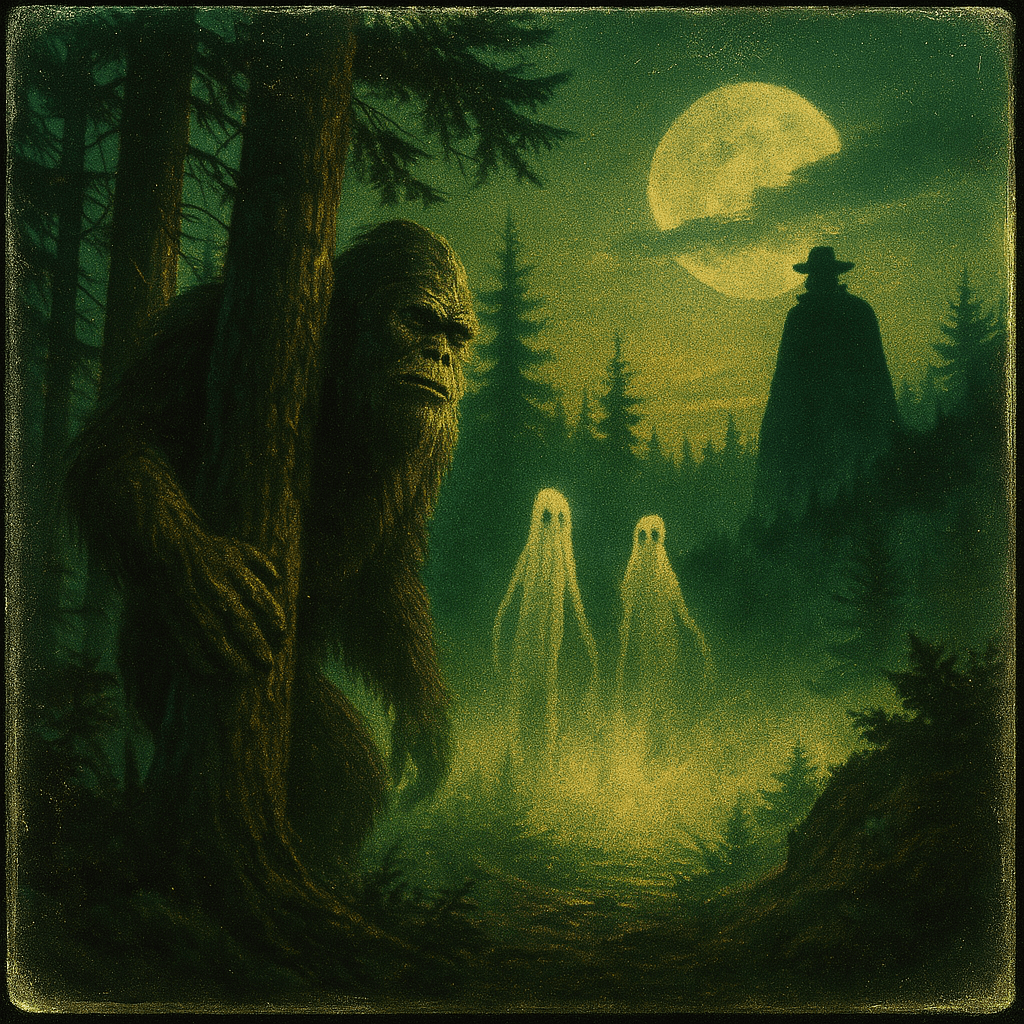
    The most famous of California’s elusive beings is, of course, Bigfoot. Towering, shaggy, and strangely silent, this creature has been spotted from the misty woods of the Pacific Northwest down to the redwood forests of Northern California. But it was the 1967 Patterson-Gimlin film, captured in the dense woodlands of Willow Creek, that cemented Bigfoot in popular consciousness. In it, a hulking figure strides confidently across a clearing, glancing briefly over its shoulder as if annoyed to be seen. Was it a person in a costume? Or something much older, much wilder—an echo of our primal past walking in modern times? Eyewitnesses continue to report encounters, often describing the same details: the smell, the silence before it appears, the feeling of being watched. Hoax or harbinger, Bigfoot has become a symbol of the unseen watching just beyond the trees.

    But Bigfoot isn’t California’s only cryptid. In the quiet city of Fresno, a security camera in 2007 captured something that seemed… not of this world. Known now as the Fresno Nightcrawlers, these creatures appear as little more than long, white legs—no arms, no torso, no discernible head. They drift across the screen like pants blown by a ghostly breeze. While some write them off as puppetry or digital trickery, others feel their eeriness is too authentic, too deliberate. In fact, similar beings have been spotted again—this time in Yosemite National Park, one of the most energetically charged natural spaces in the country. Are these Nightcrawlers alien scouts? Nature spirits? Beings from a dimension we’ve only begun to glimpse? Their form defies biology, and their movement challenges gravity itself.

    Further down the coast, in the Santa Lucia Mountains, a much older legend watches from the ridges. They’re called the Dark Watchers—tall, humanoid silhouettes that appear at twilight and silently observe hikers from afar. Spanish settlers wrote about them in the 1700s. John Steinbeck even mentioned them. Described as wearing cloaks and standing perfectly still, they never approach, speak, or chase. They only watch. Indigenous Chumash stories speak of “the old ones” who dwell in the mountains, warning of spirits who guard sacred ground. Perhaps the Watchers are echoes of these protectors—or perhaps they are something else entirely. No one has ever seen them up close and lived to tell the tale in detail.

    To the east, in the clear, cold waters of Lake Tahoe, something stirs beneath the surface. Tahoe Tessie is said to be a massive, serpent-like creature that has been seen by both locals and tourists since the 1800s. Descriptions vary—sometimes she’s sleek and smooth like a sea serpent, other times more jagged and prehistoric, like a plesiosaur that defied extinction. Scientists have dismissed the sightings as misidentified sturgeon or underwater waves. But the sightings persist. Could Tessie be hiding in the deep underwater tunnels rumored to connect Lake Tahoe with Pyramid Lake in Nevada—tunnels so cold, so black, they’ve never been fully explored?

    In Southern California, the mysteries take a different turn. In 1958, Charles Wetzel was driving near Riverside when something lunged into the road. He described a grotesque figure, taller than a man, with rough scaly skin, bulging eyes, and a mouth that stretched too wide. Its shriek echoed through his car as he sped away in terror. The encounter was dubbed the Riverside Monster, and while sightings are rare, the story endures. Was it a deformed animal? An alien displaced from its ship? Or some desert spirit pulled into this world through a crack in reality?

    And then, high in the Sierra Nevada mountains, there’s a creature more sinister than most: the Lone Pine Mountain Devil. Said to resemble a bat the size of a dog, with wings like torn leather and teeth too many to count, this creature allegedly slaughtered entire groups of Spanish missionaries in the 1800s—leaving only bones behind. Witnesses today claim to hear strange screeches in the wind or see shapes flitting between pine trees. Could the Mountain Devil be nature’s revenge? A Western cousin of the Jersey Devil? Or perhaps a cautionary tale made flesh, warning those who trespass too boldly into ancient lands?

    California is often thought of as sunshine and surf, but it holds a darker side—one filled with unexplainable sights and stories that refuse to fade. From coast to desert, mountain to sea, these cryptids represent more than just fear—they speak to curiosity, to wonder, and to the persistent truth that not everything has been discovered.

    Are these creatures mere myth, built from misidentifications and folklore? Or are they glimpses of something real—fragments of a hidden world brushing up against our own? In California, where the earth trembles and the fog rolls in thick, anything seems possible. So next time you hike a trail, walk alone at night, or glance out across the water… keep your eyes open.

    Because in California, something might be watching.